
Here's a straight up recommendation for all of you Cascadian loyalists like me. As an avid reader I have historically been disappointed with the recognition of Northwest literature. There are the New York writers (so depressing), California writers (too much for the screen), and the infamous Southern writers (racists!), but what about us Cascadians? Are we too satisfied dancing around in puddles and hiking up into the alpine to take out our pencils and jot down our thoughts? The answer is an emphatic no. And nobody says this better than The Clear Cut Press.
This independently run publishing company, based in Portland works to promote the beautiful words that flow from the minds of Cascadians (like me!). The company was formed in the early years of the new century by Matthew Stadler, founder of
Nest magazine and a former contributor to
The Stranger, and Richard Jensen, former executive of
Sub Pop Records (Nirvana's label), and co-founder of
Up Records. According to Jensen Clear Cut emerged through "conversations about economy and poetry" and as they say, because "traditional publishers may have lost sight of who reads and why".
Perhaps from Jensen's indy recording experience, the company works in true "punk rock" custom. All profits are split fifty-fifty between author and publisher. In addition, Clear Cut does not secure prohibitive rights in the 'text'. There company was not created to exploit writers and readers alike, but rather simply to bring a fresh batch of literature to a much watered-down industry.
The first subscription set from Clear Cut came out in 2005 and included short stories, essays, photographs, novels, and poetry from a host of Northwest Writers. I admittedly have not read the entire body of this work but I have put my hand in the jar, and the cookies are delicious! Here is a brief review of just some of the works from this collection.
The premier book in the series is entitled,
A Clear Cut Future. The work is a conglomeration of short stories and essays that, "map the territory of interest to Clear Cut Press". Each work starts with a set of photographs that compliment the writings to follow. As a whole, this book embodies a beautiful perspective of the Northwest world.
One novel,
Shoot the Buffalo, by Matt Briggs, is a must for the generation who grew up with flower parents. The story is told from the perspective of a military private remembering his childhood in the lumber town turned hippie farm of the Snoqualmie foothills. Well written and full of anecdotes of an "alternative" childhood the story highlights the breakdown of the "peace and love" ideals when confronted with practical, real world problems.
Core Sample: Portland Art Now, traces the history and accomplishment that was a set of two dozen art exhibitions dotting the Portland landscape in 2003. The book is full of many great color photos, sprinkled with a few essays that explain this monumental phenomenon.
But my favorite work in the entire series is most certainly,
Occasional Work and Seven Walks from the Office for Soft Architecture, by Lisa Robertson. Robertson, a creative writer/poet has developed a distinctly new perspective on urban studies. She walks the streets of Vancouver and surrounding British Columbia thinking very critically about how and why we build the way we build, and how that effects our lives, physically as well as mentally. I will end this blatant promotion for Clear Cut, at the risk of being incredibly long-winded, with the entirety of
Soft Architecture: A Manifesto. Enjoy, and check out
Clear Cut Press on the web for more info.
The Office of Soft Architecture came into being as I watched the city of Vancouver dissolve in the fluid called money. Buildings disappeared into newness. I tried to recall spaces, and what I remembered was surfaces. Here and there money had tarried. The result seemed emotional. I wanted to document this process. I began to research the history of surfaces. I included my own desires in the research. In this way, I became multiple. I became money.
The worn cotton sheets of our little beds had the blurred texture of silk crepe and when we lay against them in the evening we'd rub, rhythmically, one foot against the soothing folds of fabric, waiting for sleep. That way we slowly wore through the thinning cloth. Our feet would get tangled in the fretted gap.
We walked through the soft arcade. We became an architect.
The knitted cap on the wrinkled skull of the mewling kid is the first boundary. At the other tip the bootie dribbles. There are curious histories of shrouds. That is not all. Memory's architecture is neither palatial nor theatrical but soft.
Of course it's all myth. Beginning at grand rooms rankled in small stone Natufian couples co-mingled in kisses, the perspex galleries of pendant Babylonian dollies, the long halls of Egyptian cats that are sirens or dynasties, we amble towards the disappearance of godliness in cloth. Europe's lusty godlets start bending. Carved cloth connotes the wild swirls of the Christly sexual parts. Sprigged calico greets the renaissance of Venus. Prudery flows animate, clinging, vivid - we think it absorbs virility from naked Antiquity herself. Strolling from Byzantium we observe her teasing retreat. The mischievious and the sexy gods get dressed as patrons and courtesans and popes, crinolined in Fragonard's stiff satins, diminished to tiny petticoated players in painted enamel frolics. Finally invisible they loll in the latent conventions of canvas, or in the draperies and objets of the room themselves, such as the Frick's crushed mohair swags, the personified tapestry walls, the little petit-pointed chairs personified, the chamberpot, the silken floor personified.
We arrive at our long century. We note that the holy modernism of the white room is draped and lined in its newness by labile counter-structures of moving silk, fur, leather, onyx, velvet. The modernist inventors of the moot science of psychoanalysis raise its cold visage from the deep upholsteries and ruched cushions of the speaking invalid's couch. A contemporary describes the late Maria Callas's vibrato as "a worn velvet that has lost the evenness of its texture." As for us, we wear avant-thrift. We sit in spider-like chairs. But Soft Architecture expires invisibly as the mass rhetorics of structural permanence transmit: Who can say when the astonishing complicities of the woven decay into rote? The bare ruin of Bauhaus and the long autopsy of concepts serve as emblems of Soft Architecture's demise.
Yet our city is persistently soft. We see it like a raw encampment at the edge of the rocks, a camp for a navy vying to return to a place that has disappeared. So the camp is a permanent transience, the buildings or shelters like tents - tents of steel, chipboard, stucco, glass, cement, paper, and various claddings - tents rising and falling in the glittering rhythm which is null rhythm, which is the flux of modern careers. At the center of the tent encampment, the density of the temporary in a tantrum of action; on peripheries over silent grass of playing fields the fizzy mauveness of seed-fring hovering. Our favorite on-ramp curving sveltely round to the cement bridge, left side overhung with a small-leafed tree that sprays the roof of our car with its particular vibrato shade. Curved velveteen of asphalt as we merge with the bridge-traffic, the inlet, the filmic afternoon. The city is a florescence of surface.
Under the pavement, pavement. Hoaxes, failures, porches, archeological strata spread out on a continuous thin plane; softness and speed, echoes, spores, tropes, fonts; not identity but incident and the accumulation of air miles; unmarked solitude absorbing time, bloating to become an environment, indexical euphorias, the unraveling of laughter; a brief history of escalators; memory manifest, brindled, loosening; a crumpling of automative glass; the pornographic, the wrapped; Helevetica's black dust: All doctrine is foreign to us. The problem of the shape of choice is mainly retrospective. That wild nostalgia leans into the sheer volubility of incompetence. The nostalgia musters symbols with no relation to necessity - civic sequins, apertures that record and tend the fickleness of social gifts. Containing only supple space, nostalgia feeds our imagination's strategic ineptitude. Forget the journals, conferences, salons, textbooks, and media of dissemination. We say thought's object is not knowledge but living. We do not like it elsewhere.
The truly utopian act is to manifest current conditions and dialects. Practice description. Description is mystical. It is afterlife because it is life's reflection or reverse. Place is accident posing as politics. And vice versa. Therefore it's tragic and big.
We recommenders of present action have learned to say "perhaps" our bodies produce space; "perhaps" our words make a bunting canopy; "perhaps" the hand-struck, palpable wall is an anti-discipline; "perhaps" by term "everyday life" we also mean potential. We allude sympathetically to the lyrical tone of clothing and furniture since they clearly reveal to the eye, mind, and judgement the real shapes of peopled sentiment. Cravats gushing from collars, we agree with the Soft Architect Lilly Reich that "clothes may also have metaphysical effects by means of their inherent regularity, their coolness and reserve, the coquettish cheerfulness and liveliness, their playful grace, their sound simplicity and their dignity." From the vast urbanity of our counter-discipline we applaud the mercurial Miss Reich, who said, "One of my hearts is in building."
Soft Architecture will reverse the wrongheaded story of structural deepness. That institution is all doors but no entrances. The work of the SA paradoxically recompiles the metaphysics of surface, performing a horizontal research which greets shreds of fiber, pigment flakes, the bleaching of light, proofs of lint, ink, spore, liquid and pixilation, the strange, frail, leaky cloths and sketchings and gestures which we are. The work of the SA, simultaneously strong and weak, makes new descriptions on the warp of former events. By descriptions, we mean moistly critical dreams, morphological thefts, authentic registers of pleasant customs, accidents posing as intentions. SA makes up face-practices.
What if there is no "space," only a permanent slow-motion mystic takeover, an implausibly careening awning? Nothing is utopian. Everything wants to be. Soft Architects face the reaching middle.

 Of coures, this does not mean that the islands have remained unpopulated. In fact, Coast Salish Natives had a host of settlements throughout the islands and many of them remain today. In the 1930's, as transportation methods improved, British Columbia began promoting the area as a regional tourist destination. The peace, serenity, and lack of infrastructure on the islands attracted many nature lovers who desired unobstructed exploration. In the 1960's the islands became a hot spot for American draft dodgers looking to hide out from the authorities. More recently, many wealthy celebrities have found the Islands' tranquil landscape the ideal place for large vacation homes.
 The hodge-podge mix of First Nations peoples, draft-dodging hippies, and urban weary nature lovers, has made the Islands famous for their alternative lifestyle. No where is this more prevalent than on Salt Spring Island. Salt Spring is home to over 10,000 of the Islands' 25,000 residents with its capital in the small town of Ganges. here, every Saturday, over 150 vendors gather in Centennial Park to sell everything from home-grown berries to hand-crafted benches. In its early days the market was a place for individuals strewn about the islands to swap books, or borrow cooking supplies without having to return to the mainland. But over the years, the market has grown in popularity, bringing in hundreds if not thousands of tourists every weekend. True to the Gulf Island style though, a rule was implaced in 1992 that allowed only Salt Spring residents to sell goods, and the vendors must, "make it, bake it, or grow it" to recieve a permit. In addition, the residents developed their own currency, called the Salt Spring Dollar which is accepted on-par with the Canadian dollar on the island. Many of the other islands cling to this simpler lifestyle as well. Many of the islands still lack electricity and the Galiano Island community of 1,100 residents has managed to survive on only 28 inches of yearly rainfall for all of their water needs.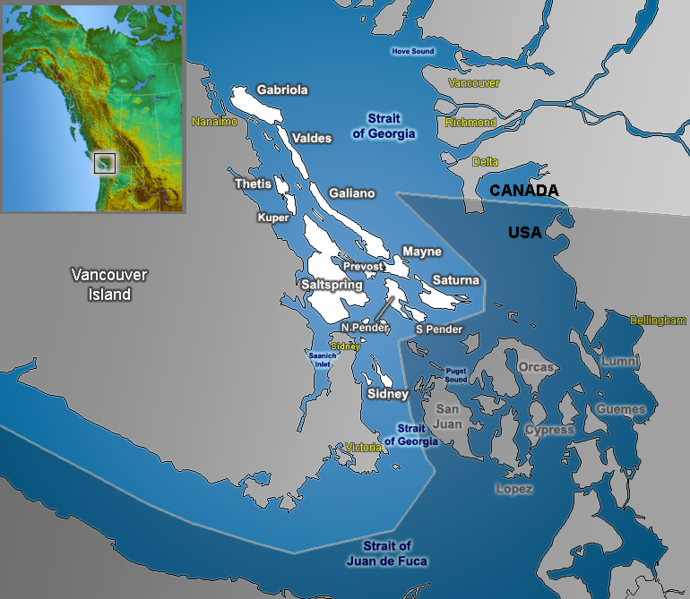


cas1.gif)

cas2.gif)


