Tuesday, December 18, 2007

Rudyard Kipling's Cascadian Journey

Rudyard Kipling was an Englishman born and raised in India during the second half of the 19th century. He became a writer for Indian magazines at an early age and soon after, began writing stories about his travels and experiences in the Indian interior. He is most famous for his novel, "The Jungle Book" as well as his short stories, such as, "Riki-Tivi-Tavi".

But, what is little known about this historic writer is his travels to America. In March 1889, at the age of 23 and before his international recognition, he sailed from India, through Southeast Asia and landed in San Fransisco on a legendary journey through the American continent. From San Fransisco he headed north, through Oregon and Washington, then up to British Columbia. The notes and remarks that he has about the Cascadian region are undoubtedly interesting.

There is nothing like an outsider's perspective to really understand the history of a place. Kipling dissects the Northwest like an anthropologist, pointing out all of the quirks that make up this region and its people. I would highly reccommend a read, of the whole book, Sea to Sea, but for now you can enjoy some of these great excerpts about Cascadia and its history. Enjoy!

In the late 19th century, salmon fishing was still an incredibly popular and lucrative job. Here, Kipling writes to Indian fishers about the unbelievable abundance of fish in the Northwest:

I HAVE lived! The American Continent may now sink under the sea, for I have taken the best that it yields, and the best was neither dollars, love, nor real estate. Hear now, gentlemen of the Punjab Fishing Club, who whip the reaches of the Tavi, and you who painfully import trout to Ootacamund, and I will tell you how “old man California” and I went fishing, and you shall envy. We returned from The Dalles to Portland by the way we had come, the steamer stopping en route to pick up a night’s catch of one of the salmon wheels on the river, and to deliver it at a cannery downstream. When the proprietor of the wheel announced that his take was two thousand two hundred and thirty pounds’ weight of fish, “and not a heavy catch, neither,” I thought he lied. But he sent the boxes aboard, and I counted the salmon by the hundred—huge fifty-pounders, hardly dead, scores of twenty and thirty-pounders, and a host of smaller fish.


From Portland, Kipling decided to take a little fishing trip of his own on the Clackamas River. The insurance man, "Portland", had gotten him a team and crew together for the short journey, but inevitably, it was not quite up to the standards that Kipling expected:


The team was purely American—that is to say, almost human in its intelligence and docility. The bystanders overwhelm[ed] us with directions as to the sawmills we were to pass, the ferries we were to cross, and the sign-posts we were to seek signs from. Half a mile from this city of fifty thousand souls we struck (and this must be taken literally) a plank-road that would have been a disgrace to an Irish village. All the land was dotted with small townships, and the roads were full of farmers in their town wagons, bunches of tow-haired, boggle-eyed urchins sitting in the hay behind. The men generally looked like loafers, but their women were all well dressed. Then we struck into the woods along what California [a guide] called a “camina reale,”—a good road,—and Portland a “fair track.” It wound in and out among fire-blackened stumps, under pine trees, along the corners of log-fences, through hollows which must be hopeless marsh in the winter, and up absurd gradients. But nowhere throughout its length did I see any evidence of road-making. There was a track,—you couldn’t well get off it,—and it was all you could do to stay on it. The dust lay a foot thick in the blind ruts, and under the dust we found bits of planking and bundles of brushwood that sent the wagon bounding into the air. Then with oaths and the sound of rent underwood a yoke of mighty bulls would swing down a “skid” road, hauling a forty-foot log along a rudely made slide.


Eventually they did make it to the Clackamas and here the scenery was a bit more tranquil:

That was a day to be remembered, and it had only begun when we drew rein at a tiny farmhouse on the banks of the Clackamas and sought horse-feed and lodging ere we hastened to the river that broke over a weir not a quarter of a mile away. Imagine a stream seventy yards broad divided by a pebbly island, running over seductive riffles, and swirling into deep, quiet pools where the good salmon goes to smoke his pipe after meals. Set such a stream amid fields of breast-high crops surrounded by hills of pine, throw in where you please quiet water, log-fenced meadows, and a hundred-foot bluff just to keep the scenery from growing too monotonous, and you will get some faint notion of the Clackamas. How shall I tell the glories of that day so that you may be interested? Again and again did California and I prance down that reach to the little bay, each with a salmon in tow, and land him in the shallows. Then Portland took my rod, and caught some ten-pounders, and my spoon was carried away by an unknown leviathan. Very solemnly and thankfully we put up our rods—it was glory enough for all time—and returned weeping in each other’s arms—weeping tears of pure joy—to that simple bare-legged family in the packing-case house by the waterside.


Next Kipling's American guide, California, took him North to see the boom town of Tacoma:

California was right. Tacoma was literally staggering under a boom of the boomiest. I do not quite remember what her natural resources were supposed to be, though every second man shrieked a selection in my ear. The rude boarded pavements of the main streets rumbled under the heels of hundreds of furious men all actively engaged in hunting drinks and eligible corner-lots. They sought the drinks first. The street itself alternated five-story business blocks of the later and more abominable forms of architecture with board shanties. Overhead the drunken telegraph, telephone, electric light wires tangled on the tottering posts whose butts were half-whittled through by the knife of the loafer. Down the muddy, grimy, unmetaled thoroughfare ran a horse-car line—the metals three inches above road level. Beyond this street rose many hills, and the town was thrown like a broken set of dominoes over all. A steam tramway—it left the track the only time I used it—was nosing about the hills, but the most prominent features of the landscape were the foundations in brick and stone of a gigantic opera house and the blackened stumps of the pines. California had gone off to investigate on his own account, and presently returned, laughing noiselessly. “They are all mad here,” he said, “all mad. A man nearly pulled a gun on me because I didn’t agree with him that Tacoma was going to whip San Francisco on the strength of carrots and potatoes. I asked him to tell me what the town produced, and I couldn’t get anything out of him except those two darned vegetables. Say, what do you think?” I responded firmly, “I’m going into British territory a little while—to draw breath.”
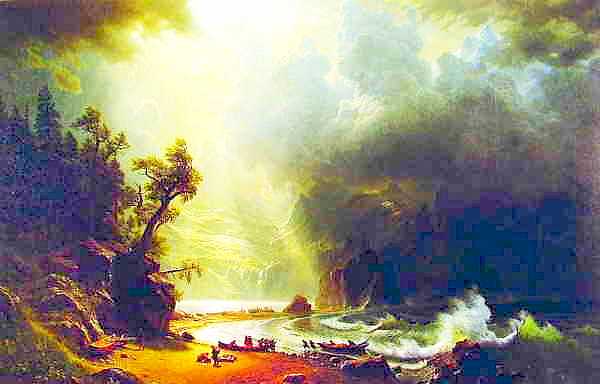

So Kipling set off for Vancouver, to relax with some of his fellow countrymen. He went by water this time, taking a long boat ride North, through the Sound:

I took a steamer up Puget Sound for Vancouver, which is the terminus of the Canadian Pacific Railway. That was a queer voyage. The water, landlocked among a thousand islands, lay still as oil under our bows, and the wake of the screw broke up the unquivering reflections of pines and cliffs a mile away. ’Twas as though we were trampling on glass. No one, not even the Government, knows the number of islands in the Sound. Even now you can get one almost for the asking; can build a house, raise sheep, catch Salmon, and become a king on a small scale.


When Kipling docked in Seattle, the city was still in the process of recovering from the Great Fire of 1889. This heavily affected his attitude towards the city:

Have I told you anything about Seattle—the town that was burned out a few weeks ago when the insurance men at San Francisco took losses with a grin? In the ghostly twilight, just as the forests were beginning to glare from the unthrifty islands, we struck it—struck it heavily, for the wharves had all been burned down, and we tied up where we could, crashing into the rotten foundations of a boat house as a pig roots in high grass. The town, like Tacoma, was built upon a hill. In the heart of the business quarters there was a horrible black smudge, as though a Hand had come down and rubbed the place smooth. I know now what being wiped out means. The smudge seemed to be about a mile long, and its blackness was relieved by tents in which men were doing business with the wreck of the stock they had saved. Here were shouts and counter-shouts from the steamer to the temporary wharf, which was laden with shingles for roofing, chairs, trunks, provision-boxes, and all the lath and string arrangements out of which a western town is made.


In June of 1889, to Kipling's relief, he finally made it across the border into British owned Columbia territory, and the city of Vancouver:

Except for certain currents which are not much mentioned, but which make the entrance rather unpleasant for sailing-boats, Vancouver possesses an almost perfect harbor. The town is built all round and about the harbor, and young as it is, its streets are better than those of western America. Moreover, the old flag waves over some of the buildings, and this is cheering to the soul. The place is full of Englishmen who speak the English tongue correctly and with clearness, avoiding more blasphemy than is necessary, and taking a respectable length of time to getting outside their drinks. A great sleepiness lies on Vancouver as compared with an American town: men don't fly up and down the street telling lies, and the spittoons in the delightfully comfortable hotel are unused; the baths are free and their doors are unlocked. You do not have to dig up the hotel clerk when you want to bathe, which shows the inferiority of Vancouver. An American bade me notice the absence of bustle, and was alarmed when in a loud and audible voice I thanked God for it.


The peaceful beauty and gentility of Vancouver had a lasting impact on him, and 15 years later, with money from his novel sales, he purchased a number of plots in and around Van City. Unfortunately not all of these deals were totally legitimate. In later years Kipling found out that a large piece of property in North Van, which he had been paying hefty taxes on, was not actually titled to him! In addition, two small parcels he bough on the East side of Vancouver for $500, he sold over 20 years later for $2,000. This would have been a pretty good deal unless you count the $60 a year taxes he had paid. I guess Vancouverites were just as money hungry as Americans in the end. It was just the spirit of the booming Northwest. Profits were there to be had, but you had to work hard (i.e. lying, cheating, and stealing) to get them.

Kipling's writings about Cascadia give us an interesting insight into the boomtown years of abundant resources, big ideas, and a whole host of individuals looking to cash in. Our cities were built on these foundations, but we should use it as a wary lesson for future progress.

Sources:
Pictures:

Sunday, December 16, 2007

The Scorecard 2007


Surfing (or, more relatable to Cascadians, snowboarding) the web recently, I came across what might be called the Holy Grail of Cascadian affairs. The Sightline Institue, "is a not-for-profit research and communication center" working to, "bring about sustainability--a healthy, lasting prosperity grounded in place". And that place is Cascadia. The Institute manages two Cascadia-specific news blogs, The Daily Score and Tidepool (neither as good as mine of course), and also does specific research projects on Cascadian related issues, such as the impacts of highway-widening, relevant to Puget Sound's Roads and Transit and B.C.s Gateway Program. But the true goal (and treasure) of the Sightline Institute is their regional research on Cascadia that is comparable to other areas of the world. While I (and many of you I hope) feel Cascadian at heart, the fact remains that Cascadia is (as yet?) only cultural, not political. Therefore acquiring statistics and data specific to the region requires combining state, provincial, national, municipal, and other sets of figures; a monumental and time consuming task to say the least. Well, until I came across the Sightline Institute that is. I mean, just check out maps like this, or this! Perhaps you aren't quite as excited as myself about these random colorful pictures of Cascadia, but having been seriously researching Cascadia for the last couple of months, The Sightline Institute is bringing Cascadia into a whole new realm of genuine reality. I can guarantee that many future posts will use research and information from this premier Cascadian institution.


So, now that I am done raving about this glorious find, I can move on to the actual post, which is a summary of Sightline's recent publication, Cascadia Scorecard 2007: Seven Key Trends Shaping the Northwest.

"The Cascadia Scorecard, a project started in 2004 by the Sightline Institute, measures long-term progress in the Pacific Northwest. An index of seven trends shaping the future of the region, it is a simple but surprisingly far-reaching gauge. The scorecards indicators - health, economy, population, energy, sprawl, wildlife, and pollution - provide status reports for Cascadia and, by highlighting successful communities, offer a practical vision for a better Northwest."


If you want to read the full 68-page report, click here. Or, just trust that I did and read the following handy-dandy recap.


1. Health

Certainly one of Cascadia's strong points. Life expectancy is at 79.5 years, which would rank 12th if Cascadia were an independent nation. The Sightline Institute's model goal is 81.3 years, Japan's 2001 life expectancy, and thus, even at the currently slow pace, this goal is reachable within 11 years. Of course, it is important to note that gains in health have been uneven. British Columbia, "remains far and away the healthiest jurisdiction". The metropolitan areas of BC's South are some of the healthiest places on earth, while the healthiest places of Oregon and Washington aren't even standouts in the US. The healthcare system in BC as well as the compact communities of metro Vancouver both factor into its success. In 2007 Washington state increased access to preventitive health care which could help boost scores in the future.

2. Economy


The economy is a bit difficult to deduce. On the up-side Gross Regional Product grew by 72% from 1990 - 2005, while total personal income grew by 56% in the same period (inflation-adjusted). Yet, it looks as though medium and low-income households have seen almost no actual change in that 15 year period, British Columbia actually showing a slight decline. Other economic measrements, such as economic security and unemployment, have seen many ups and downs in recent years and there seems to be no set direction towards progress. The Sightline Institute concludes that without more regional research by policymakers, "Cascadia is flying blind" as far as its economy, tending to rely on national progress for improvements.

3. Population

The population growth of Cascadia has remained fairly constant over the past two decades with a birth rate of about 1.8. The target here is 1.7 (that of many Scadanavian countries) but unfortunately progress is going slow. The tendency is that more rural areas have higher rates (closer to 2) while metropolitan areas have lower rates (closer to 1). Thus, The east side of the Cascades (aside from Spokane) tends to be the area where the most improvement can be done. The most important issue is minimizing the amount of unwanted pregnancies. We are on the right track since recently both Montana and Oregon joined Washington and California in allowing for more equal treatment of prescription contraceptives. Another way to lower unwanted pregnancies is through economy as data shows that as income decreases, birth rates increase.

4. Energy

By far the worst-performing area on the scorecard. The Sightline found that Cascadia is region, "every bit as profligate with energy as it was three decades ago". Of course, not all the news is bad. Gasoline consumption has been falling consistently for the past seven years. Sadly, to offset this, electricity has seen a sudden jump in recent years. Sightline looks to Germany as a model for Cascadia where energy consumption is half and total standard of living is higher. Some measures that we can take to achieve this is carbon-based taxes, better city planning and public transportation, and probably the biggest, better awareness and concern for energy use.

5. Sprawl

While traditionally sprawl has been a bane of Cascadian communities, Sightline found that the compacted living arragements are making a resurgence in the area. In fact, the model for Cascadia overall is the metro area around Vancouver, BC. Although far from perfect, Vancouver has done a fine job with infill, protecting open space, and building close-knit communities where walking and public transportation are easy and efficient. In recent years Oregon has also been a leader in this area. Hoping to protect their traditional farmlands they have carefully channeled groth into urban areas. This is not to say that everything is on the right track. In 2004 Oregon's Measure 37 was a big set back for sprawl, allowing developers to gain compensation for developed lands. But, as a whole Cascadia seems to be slowly heading in the right direction, with speed picking up consistently.

6. Wildlife


Modest gains in wildlife numbers have been shown in recent years, mainly from Wolf populations in Idaho and Chinook salmon runs. Of course, even on the present course it would take 69 years to meet the Sightline's target goals, which themselves are only a fraction of historic population sizes. One huge target needs to be improving the waters of Puget Sound and the Columbia River, both areas full of toxic chemicals from idustrial endeavors. As well, creating protected wilderness areas for animals, such as wolves, to roam can be crucial. Wolves, who have rebounded from near extinction, play an unprecedented role in the ecological system of Cascadia. Allowing them the space and freedom to roam will help control and balance many other parts of the ecosystem within the region. Smart and managed building (such as dams and urban sprawl) will also play a large factor in the health of our future wildlife.

7. Pollution

Contamination in Cascadian bodies is high, just like much of the rest of the United States and even the world. Since data testing on this subject is still in its infancy, finding any solid trend is difficult. Luckily, governmental and popular awareness is increasing but the effects of our past mistakes are probably going to haunt us for years to come. Dealing with toxic waste sites, such as the Duwamish River, and making sure that future construction pays close attention to the environmental effects will be paramount over the next few decades.

Conclusion

There are four important lessons to take away from this publication. First, energy consumption is "stuck in high gear" and drastic actions need to be taken to decrease this. Second, British Columbia performs on average far better than the rest of Cascadia. BC's health care system is foundational to health, fertility, and even economic stability. As well, a comprehensive transportation plan, which has far fewer roads and highways than the Norhtwest States, stems sprawl, protect environment, lowers pollution, and increase health. Cascadians should be championing their own successes and looking internally to British Columbia instead of to the rest of the United States for future leadership. Third, while human inhabitants of Cascadia are doing fairly well, other most other creatures in the environment are barely holding on. We need to look critically at where we are building and growing and how we can maintain a wildlife that is abundant and healthy. As one of the last colonized places on earth, Cascadia's wildlife should be more intact than most elsewhere. It should be a regional goal to make this happen. Fourth, and finally, there is reason for optimism. While not all areas are showing significant improvement, few are showing rapid decline either. Awareness and understanding of the issues that plague our region at least give us the knowledge to do something about it.

Saturday, December 15, 2007

The Uptight Seattlite


If anyone has not read the Seattle Weekly column, Ask An Uptight Seattlite, you're pretty much missing out on happiness. Every week he answers reader questions with smart, hilarious answers. This week was particularly full of hilarity, and so I could not help but post it, enjoy.


When my friend from D.C. visited in the summer, I was telling him about my participation in the "100-mile diet." That's where, for the good of the environment, you eat only things grown within a hundred miles of Seattle. Not only did he decline to join me, he thought the whole thing was laughable. In fact, he thought our city was full of hilarity. How we march earnestly around Green Lake clutching bottles of water. The way we always dress like we're going camping. The way we get so comically worked up about transportation issues. Now he's coming to visit for Christmas, and I'm worried that he'll think we're laughable in a whole new way: the way we suck all the fun out of the holidays with our superserious "sensitivity." What can I do to show him that we know how to have a good time?

Take this Stick From My Ass

Dear Stick From My Ass,

Is it really so restrictive and dreary to live here? If you really think so, you should take a holiday of an entirely different kind. You know how Amish young people are allowed, for a set period of time, to drink, smoke, and otherwise break the rules of their community? Well, you, too, should take your own little rumspringa from Seattle ways. Show your friend you can "loosen up" with the best of them. Stop recycling. Drink macrobrews and watch NASCAR. Drive everywhere. Don't wave when someone lets you change lanes. Kill spiders in your house rather than trapping and freeing them in a silently improvised ceremony of karmic self-blessing. Do all your holiday shopping at Wal-Mart and have them double-bag everything. Go to Sea-Tac and innocently ask where the Christmas tree is. Say, "There is no Christmas tree? Why ever not?" Walk around with a cell phone pressed to your ear at all times, even if no one's on the line, and say things like, "Yeah, that's one sales forecast I'd like to see, let me tell you what, you crazy bastard! You still in for tonight, you miserable cocksucker? Shooters at Hooters, my friend, shooters at Hooters!" Do this at every farmers market in town. Put down your phone only long enough to tell the Vietnamese farmer that his organic tomatoes are lumpy and not as red as the ones at Safeway. Ask Grease Monkey for all their used oil and pour it into the gutter in front of your house while glaring defiantly at your neighbors. Rent a Hummer and tailgate Vespas. Lean on the horn as you call out, "Get a car, Fancy Man!" Finally, go downtown and, in your loudest, heartiest voice, wish every stranger you see a merry Christmas. If you find that that kind of thing makes you feel good, I suggest you take yourself to Houston for a permanent rumspringa.

The Program


So I don't talk about music much but I had to throw this in there. Blue Scholars, a Seattle based hiphop duo, has recently gotten national recognition for their new album release, Bayani. If you've heard them you will know that they are not only incredibly talented but dedicated to promoting a Northwest style and a Northwest sound. And they are certainly succeeding (check out this song or this video)! Well, in an effort to bring about even more recognition for a NW sound Blue Scholars are hosting The Program. This 5-day set of shows has an all-NW lineup with artists from Vancouver down to Portland. It's events like these, building a cultural identity through regional art, which is really going to establish Cascadia in the hearts and minds of its citizens! Get your tickets soon!

Thursday, December 13, 2007

Sasquatch Militia


This little tid-bit is from the same early Cascadian era as The Tree Octopus, back when Cascadia was a fun fabrication (and part of numerous internet spoofs by Lyle Zapato). As I don't have time for a real post enjoy this little bit of classic history.

"Join the Sasquatch Milita...
Are you an able-bodied Sasquatch aged 10 to 150 who loves his or her country? If so, The Republic of Cascadia needs YOU to enlist in the Sasquatch Militia and defend our homeland against our many enemies, including such nefarious evildoers as:
  • Canadians
  • Southern Californians
  • Geoduck and Tree Octopus Poachers
  • Paraterrestrials
  • Americans
  • International Organized Crime Syndicates
  • Nosey Cryptozoologists
Besides serving your country, you will also be improving yourself. Sasquatch Militia will teach you many valuable skills that today's employers are looking for in Sasquatch. You will gain a sense of determination and confidence that will help you succeed. And you will also experience compatriotship with your fellow Sasquatch as you work together to secure the freedom of the Republic of Cascadia.

The Republic of Cascadia needs you now, more than ever, in these trying times. Do your part for your nation and don't let another Sasquatch take your place in the ranks of the Sasquatch Militia. Enlistment stations can be found throughout Cascadia's forests, just look for the poster of Uncle Sas."
Full info here.

Tuesday, December 11, 2007

The Weekly Alternative


News from Alternative Newspapers across Cascadia:

[The Georgia Straight]: Gordon McAdams wins the "Whistleblower of the Year Award" for calling out city planners, and subsequently being fired, concerning a road through Groham Narrows Provincial Park.

[Monday Magazine]: Although Victoria's needle exchange program has undeniably good intentions, neighborhood complaints have gotten the program, run by AIDS Vancouver Island, evicted from its buidling, leaving addicts without a safe needle supply.

[Cascadia Weekly]: Bellingham's efforts to court NOAA, the National Oceanic and Atmospheric Administration, got a large boost this week as U.S. Congressman Rick Larsen gave his endorsement to the city. NOAA, currently based in Seattle, announced plans to move locations earlier this year. Bellingham hopes to give it a new home on the old Geogria Pacific waterfront, handed over to the city and currently in the process of redevelopment.

[Boise Weekly]: The 6th Annual Bad Cartoon Contest has commenced and this year, the winner is, well, pretty bad. Sifting through Larry Craig antics along with a number of talking poop stories, Elijah Jensen was declared the winner. His cartoons generally revolve around teeth. Look for Jensen's cartoons for the next 52 weeks in the Boise Weekly.

[Pacific Northwest Inlander]: Not a whole lot of news going on in Spokane right now but the Inlander did produce an ALL LOCAL Christmas (sorry, holiday) shopping guide for the area. In other news, Mary Verner, the liberal (hybrid driving) mayoral candidate, was finally sworn into office. Way to be progressive Easties!

[Seattle Weekly]: In typical Seattle fashion, the Weekly ran a feature about the meatheaded idiocy of Pullman (which no doubt is true). Kyle Schott, a top football pick back in 2003, recently went to court for sexual assault charges against a Kappa Alpha Theta Sorority girl. Apparently, Schott was originally waiting, "to hear from the U Dub". I think WSU was a better fit.

[The Stranger]: No real news from The Stranger this week (except the typical rantings about development and racial discrimination in the city). Currently the paper's annual charity, Strangercrombie, is the talk of the town (or at least Capitol Hill) Hurry over to The Stranger Online to bid on some incredibly unique packages, including a personally picked cover done by the Presidents of the United States, or your very own spot on The Slog for a week! (if anyone wants to "lend" me $600 I'll happily talk up Cascadia to all the Strangerheads.)

[Vancouver Voice] What is with Cascadians and dirtying up their rivers? (see my previous post on The Duwamish) Sure, we've banned the major toxic troubles from The Columbia, like PCBs and DDT, but now even our personal hygiene products are killing The River's ecosystem. Apparently making those teeth reflectively white isn't exactly environmentally friendly.

[The Portland Mercury]: Another big 'ol auction, this time for Stumptowners. This year's proceeds will go to Sisters of the Roads, an organization dedicated to helping feed the homeless around Portland.

[Willamette Weekly]: 10 years after the signing of the Kyoto Protocol and it looks like not much has been accomplished. While 130 nations take part in more climate talks this week, in Bali, WW wonders why the hell nothing is really happening.

[Eugene Weekly]: Also bitching about global warming, Eugene is criticizing a little more locally. Eugene Mayor Kitty Piercy recently cast the deciding vote for a $500 million dollar regional freeway expansion project. While Piercy signed on to Seattle Mayor Nickels' US Mayoral Climate Action Plan, many see this as a huge step backwards. Of course, Seattle itself is having quite a few road disputes of its own these days.