

(Queen Anne Ave. between Aloha and Highland)
 Blue Moon Tavern in Seattle, courtsey of Wikipedia.
From the Emerald City to Bridgetown down South
An Ode to Cascadia I sing from my mouth.
With it's mountains so mighty and its trees oh so tall,
We drink to Cascadia 'cause it's got it all.
Cheers! to Cascadia with all of it's green,
Where the women like it dirty and the waters are clean.
Cheers! to Cascadia let the rain fall outside,
We'll dance in the puddles while the foreigners hide.
We've got breweries a plenty, the best pot around,
and Autumn brings magical fruit from the ground.
In winter the snow piles high on the peaks,
and long summer nights let us stay out and drink!
Cheers! to Cascadia with all of it's green,
Where the women like it dirty and the waters are clean.
Cheers! to Cascadia let the rain fall outside,
We'll dance in the puddles while the foreigners hide.
We pour,
One for the Salmon who's homes all got dammed,
by greedy capitalists here in this land.
But now we have wisdom, we've learned from the past,
We must work with nature to make this land last.
Cheers! to Cascadia with all of it's green,
Where the women like it dirty and the waters are clean.
Cheers! to Cascadia let the rain fall outside,
We'll dance in the puddles while the foreigners hide.

 If there was an award for greenest brew practices (which there sure as hell should be!) it would most certainly go to Anderson Valley Brewing Company. Based in Boonville, Ca, at the heart of the Emerald Triangle, this brewery is so eco-friendly I don't even know where to begin! Let's see, the company really took off in 1999 when they built their new, three-story, state-of-the-art brewhouse . They situated the building so that only one tree had to be removed, and they planted two more in its stead. The new facility boast a fully solar-powered brewing process as well as a three-pond effluent waste water treatment system. This means that water used to brew the beer is also used for heating and chilling beer, cleaning the facilities, and eventually irrigating all 30 acres of the company's property. The brewery also utilizes and supports its local community. All water used by the brewery is taken from wells on their property. The hops are all certified organic and grown in the Pacific Northwest. In addition, after using the grains for brewing they clean it, then donate it to local livestock owners. They estimate that they give away approximately 2000 tons of nutrient grains a year. These efforts have gotten them numerous awards from California's Waste Reduction Awards Program. In fact, AVBC is so environmentally conscious that they recently acquired four shire horses which they use to haul beer to local stores and pubs in the area (fed with the spent brew grains of course!).
 Down in Oregon Country the Full Sail Brewing Company, based in Hood River, has gained recognition for its social responsibility. In 1999 after 12 years of brewing and 47 workers the company became an independent, employee-owned company, dividing the company between all workers. Under this ideology the company has been able to implement a number of innovative practices that have helped them reduce their environmental impact. For example, the company runs 4 10-hour work days which saves 20% on water and power consumption. 85% of hops and 95% of barley used in Full Sail Ales are grown in the Northwest and through various minor fixes they have reduced their water consumption to only 3.45 gallons of water for every gallon of beer (the industry average is between 6 and 8).
 While nothing to date can compete with Anderson Valley, Olympia, Washington's Fish Brewing Company has been giving back to the environment since 2002. As their name suggests they try to promote the protection and rehabilitation of salmon habitat's throughout Cascadia. Their three main beers, amber, Pale, and IPA are all certified Organic. Their signature beer the Wild Salmon Pale Ale uses hops from a Yakima, Washington farm which was the first farm to producecomercially organic hops in the United States. A portion of the proceeds from this beer also goes towards salmon restoration and watershed protection. I also must mention the fact that all six-packs of Fish beer contain the proclamation, Brewed in the Republic ofCascadia. You gotta love that!
 Of course, lets not leave BC out of this! Crannog's Ales has the dubious title of Canada's only certified organic farm brewery. Crannog's is similar to Anderson Valley, but on a smaller scale. They brew on a 10-acre farm which feeds and sustains the brewers as well as contributes to the brewing process. They also use water from their own wells and reuse grains for livestock feed. They claim to have created a harmonized, zero-waste system. While the brewery pledges to only deliver beer within driving range of the brewery this makes it difficult to secure outside of British Columbia. Nonetheless they deserve credit for standing behind their beliefs.
 Juneau's Alaskan Brewing Company is also a committed green brewery. It is their goal to have a zero-net impact on the environment. To this end, in 1998 they were the first craft brewer in the country to install a carbon dioxide recovery system, which captures and reuses the greenhouse gas naturally produced in the fermentation process. Of course, they acknowledge that working in the harsh Alaskan environment they cannot be quite as eco-friendly as other places. Thus, they have pledged a portion of their proceeds to promote the health of the Pacific Ocean via their coastal CODE (Clean Oceans Depend on Everyone) Organization. The company has also recieved numerous awards for its outstanding health and saftey practices among its employees, thereby promoting healthy environments externally as well as internally.
Listen for the creaky voice, the strong "s" and the "low-back merger."
Most language experts believe the Pacific Northwest has no distinctive voice, no particular style or dialect. But some local linguists think that's wrong -- or at least a long-standing academic prejudice that deserves a good challenge.
Jennifer Ingle, a 27-year-old Ballard native and student of language at the University of Washington, is one of them.
"Language is part of our identity," said Ingle. Just as the Scandinavian heritage of Ballard distinguishes it from the rest of Seattle, she said, the evolution of language in the Northwest has progressed to the point where it can be distinguished from the rest of the country.
The question for the experts now appears to be whether our version of the English language has evolved enough to be considered a separate dialect.
"Linguists have generally assumed that the West is one dialect region," said Alicia Beckford Wassink, a UW professor of linguistics and mentor to Ingle.
"That may have been the case in the 1800s, when the West was being settled and there was a mixing of dialects among all the immigrants," said Wassink. But there's plenty of evidence now, she said, to suggest this region could have its own distinctive dialect.
Northwest speak.
Ingle decided a year ago to study her own neighborhood for evidence of local dialect. To some extent, she said, growing up in Ballard contributed to her interest in language.
"I used to hear people in my neighborhood speaking Norwegian," said Ingle, noting that despite her family's Scottish heritage, one of her favorite foodstuffs is lefse -- a Nordic flatbread made from potatoes.
But Ingle's study of language in Ballard was not aimed at identifying any of the neighborhood's Nordic influences. Participants were not asked to say, "Yah, sure, ya betcha." Rather, Ballard was selected as representative of the region because it is one of the oldest communities in the state, with a well-established population of native speakers.
"All the participants were born in Seattle and grew up in Ballard," said Ingle. She focused just on variation in vowel sounds because that is what most determines the different pronunciations in spoken American English.
Still, it should be noted that when Ingle presented her findings this week, it happened to be on the same day Ballard was celebrating Norwegian Constitution Day, May 17. Her study of Northwest speech in Ballard was presented in Vancouver, B.C., at the annual meeting of the Acoustical Society of America.
Among the findings: Many locals, especially women, speak in what experts call "creaky voice"; we've done away with a particular vowel used by Easterners; we really like to emphasize the "s" in words; we're not Californian and we're not Canadian.
Other determinants of dialect include differences in vocabulary and grammar, added Wassink, which are also being looked at in other linguistic studies at the UW.
"The Northwest is especially interesting because we have had almost nothing but immigration," Wassink said. "And there hasn't been as much racial or ethnic segregation as in the East. For a linguist, it's a very interesting place."
So, why do so many women talk creaky here? What's that mean anyway?
"Bill Clinton is a good example of creaky," said Ingle. Clinton's folksy speech, in which his voice sounds both scratchy and relaxed, is the opposite of "breathy" voicing, she said.
In the Northwest, Ingle's study indicates creaky voicing is popular -- especially among women. Breathy voicing, which in extreme form sounds like Marilyn Monroe's birthday song for JFK, is not big in the Northwest.
Wassink said the local popularity of creaky voicing could be how we compensate for another feature of our speech style. We've stopped using one vowel. Linguists work with 15 vowel sounds to describe spoken American English and we only use 14 of them.
Say "caught" and "cot" out loud. If you're a true Northwest speaker, the words will sound identical. Linguists call this the "low-back merger" because we've merged these two vowel sounds. On much of the East Coast, these same words will sound different. "Creaking is a way of making those distinctions that are being lost," Wassink said. Just as Bostonians tend to compensate in their speech for removing the "r" from many words, she said, we might speak creaky to compensate for refusing to use both vowels.
Another piece of evidence has to do with how Californians do something known as "fronting the vowel," Ingle said. This is considered standard to Western dialect and occurs when a speaker pronounces "rude" as "ri-ood" or "move" as "mi-oove."
"It's pretty funny sounding, actually," said Ingle, perhaps betraying a slight Northwest bias against all things Californian.


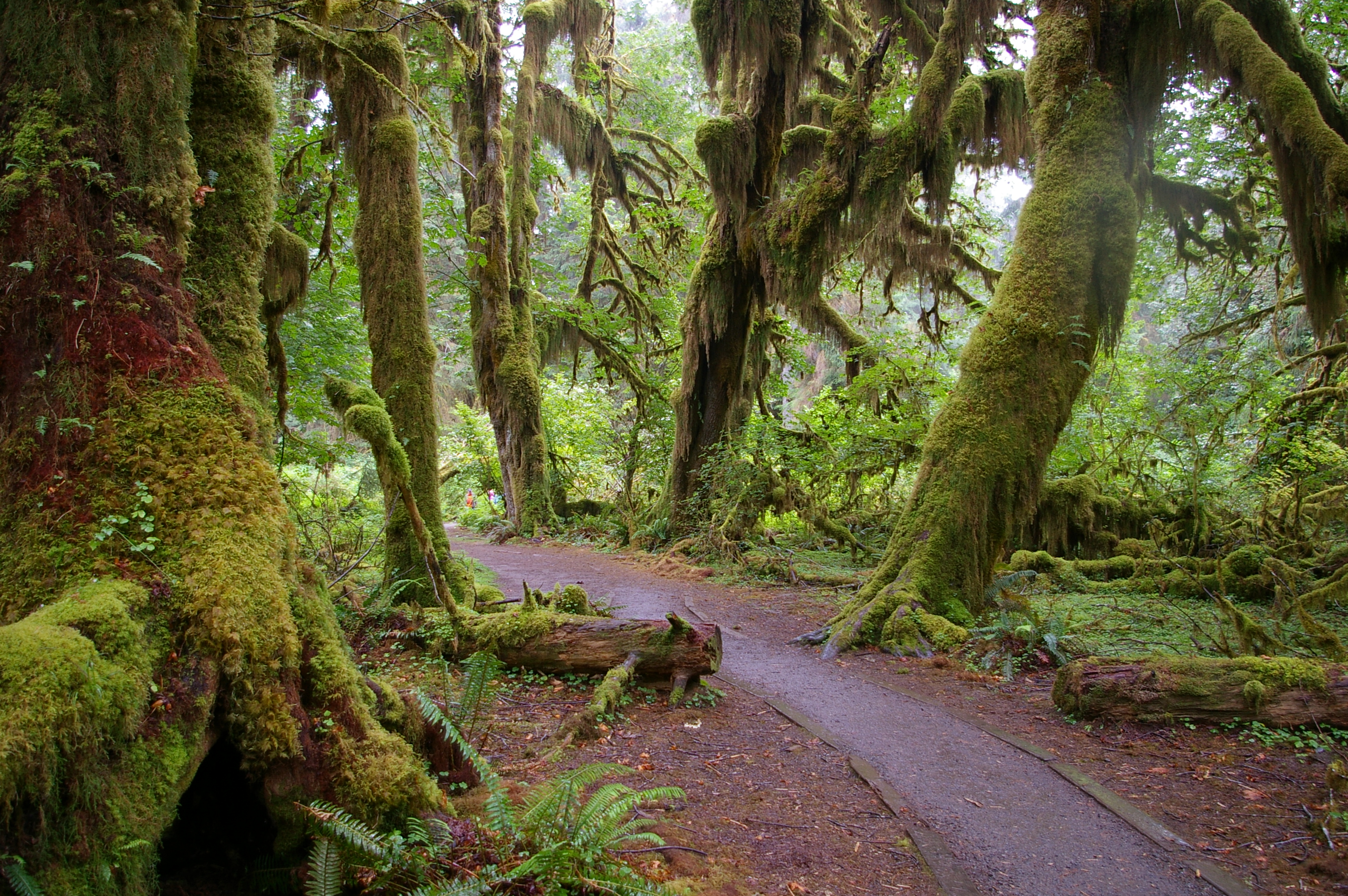
"The Cascadia Scorecard, a project started in 2004 by the Sightline Institute, measures long-term progress in the Pacific Northwest. An index of seven trends shaping the future of the region, it is a simple but surprisingly far-reaching gauge. The scorecards indicators - health, economy, population, energy, sprawl, wildlife, and pollution - provide status reports for Cascadia and, by highlighting successful communities, offer a practical vision for a better Northwest."

When my friend from D.C. visited in the summer, I was telling him about my participation in the "100-mile diet." That's where, for the good of the environment, you eat only things grown within a hundred miles of Seattle. Not only did he decline to join me, he thought the whole thing was laughable. In fact, he thought our city was full of hilarity. How we march earnestly around Green Lake clutching bottles of water. The way we always dress like we're going camping. The way we get so comically worked up about transportation issues. Now he's coming to visit for Christmas, and I'm worried that he'll think we're laughable in a whole new way: the way we suck all the fun out of the holidays with our superserious "sensitivity." What can I do to show him that we know how to have a good time?Take this Stick From My Ass
Dear Stick From My Ass,
Is it really so restrictive and dreary to live here? If you really think so, you should take a holiday of an entirely different kind. You know how Amish young people are allowed, for a set period of time, to drink, smoke, and otherwise break the rules of their community? Well, you, too, should take your own little rumspringa from Seattle ways. Show your friend you can "loosen up" with the best of them. Stop recycling. Drink macrobrews and watch NASCAR. Drive everywhere. Don't wave when someone lets you change lanes. Kill spiders in your house rather than trapping and freeing them in a silently improvised ceremony of karmic self-blessing. Do all your holiday shopping at Wal-Mart and have them double-bag everything. Go to Sea-Tac and innocently ask where the Christmas tree is. Say, "There is no Christmas tree? Why ever not?" Walk around with a cell phone pressed to your ear at all times, even if no one's on the line, and say things like, "Yeah, that's one sales forecast I'd like to see, let me tell you what, you crazy bastard! You still in for tonight, you miserable cocksucker? Shooters at Hooters, my friend, shooters at Hooters!" Do this at every farmers market in town. Put down your phone only long enough to tell the Vietnamese farmer that his organic tomatoes are lumpy and not as red as the ones at Safeway. Ask Grease Monkey for all their used oil and pour it into the gutter in front of your house while glaring defiantly at your neighbors. Rent a Hummer and tailgate Vespas. Lean on the horn as you call out, "Get a car, Fancy Man!" Finally, go downtown and, in your loudest, heartiest voice, wish every stranger you see a merry Christmas. If you find that that kind of thing makes you feel good, I suggest you take yourself to Houston for a permanent rumspringa.


 Of coures, this does not mean that the islands have remained unpopulated. In fact, Coast Salish Natives had a host of settlements throughout the islands and many of them remain today. In the 1930's, as transportation methods improved, British Columbia began promoting the area as a regional tourist destination. The peace, serenity, and lack of infrastructure on the islands attracted many nature lovers who desired unobstructed exploration. In the 1960's the islands became a hot spot for American draft dodgers looking to hide out from the authorities. More recently, many wealthy celebrities have found the Islands' tranquil landscape the ideal place for large vacation homes.
 The hodge-podge mix of First Nations peoples, draft-dodging hippies, and urban weary nature lovers, has made the Islands famous for their alternative lifestyle. No where is this more prevalent than on Salt Spring Island. Salt Spring is home to over 10,000 of the Islands' 25,000 residents with its capital in the small town of Ganges. here, every Saturday, over 150 vendors gather in Centennial Park to sell everything from home-grown berries to hand-crafted benches. In its early days the market was a place for individuals strewn about the islands to swap books, or borrow cooking supplies without having to return to the mainland. But over the years, the market has grown in popularity, bringing in hundreds if not thousands of tourists every weekend. True to the Gulf Island style though, a rule was implaced in 1992 that allowed only Salt Spring residents to sell goods, and the vendors must, "make it, bake it, or grow it" to recieve a permit. In addition, the residents developed their own currency, called the Salt Spring Dollar which is accepted on-par with the Canadian dollar on the island. Many of the other islands cling to this simpler lifestyle as well. Many of the islands still lack electricity and the Galiano Island community of 1,100 residents has managed to survive on only 28 inches of yearly rainfall for all of their water needs.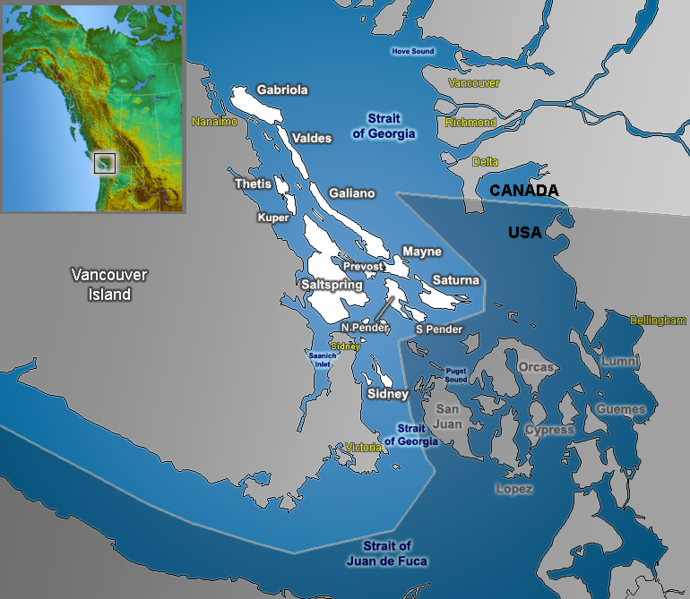

 Commonly called "The Doug" (for Douglas Fir) this is probably the most prominent flag of Cascadia. (They are featured on the Cascadian Wikipedia site). According to the creator, the blue represents the "unpolluted sky" and the plentiful water of Cascadia, the white represents the clouds and snow, and the green represents our natural vegetation. The conifer tree stands, "in defiance of storm, fire, and Man." This is the only Cascadian flag that you can currently order; smALL Flags in Oregon will do them by request. Some people are also working to try and get it produced in Hemp. Keep up on that and other info about this flag here.
 This flag was developed for the Republic of Cascadia site. Similar to The Doug, the blue and white stripes represent water and snow, while the green is for the vegetation. The red in this flag is for, "the volcanism and tectonic forces that burn beneath us". The setting sun symbolizes our place at the Western edge of North America and the fir cone is for, "rebirth, renewal, and our natural forest resources". (I'm not sure but I would guess that this one was influenced at least a bit by the flag of British Columbia.)
 This flag is for the Kingdom of Cascadia, designed by Andrew Rogers. Here we see the same green for vegetation and white for the snow-capped mountains. The seven stars (similar of coure to the "Betsy Ross" and the EU) stand for the Commonwealths, which Rogers identifies as: Alaska, British Columbia, Idaho, Oregon, Washington, and The Yukon (yes I realize thats only six, dont ask me). Rogers has also developed some Cascadian governmental and military flags that you can check out here.
cas1.gif) This flag, called the "Eight Stars" was designed by Nick Pharris. The two green triangles (the same green as the Washington State flag and representing forests and hope) stand for the mountains, as well as the US and Canada, which Cascadia bridges. The blue and white stripes, from the BC flag, represent water (loyalty) and glaciers (peace). Unlike the flag above this sun is actually rising above the mountains and represents the "rising regional consciousness". The eight stars represent the distinct Cascadian areas: Alaska, the Yukon, BC, Washington, Oregon, Idaho, Western Montana, and Northern California. The gold color is used to represent prosperity as well as the croplands and deserts of the interior. More info here. (While this one has lots of meaning, I have to say its a bit too similar to the flag of Antigua and Barbuda.)
This flag, called the "Eight Stars" was designed by Nick Pharris. The two green triangles (the same green as the Washington State flag and representing forests and hope) stand for the mountains, as well as the US and Canada, which Cascadia bridges. The blue and white stripes, from the BC flag, represent water (loyalty) and glaciers (peace). Unlike the flag above this sun is actually rising above the mountains and represents the "rising regional consciousness". The eight stars represent the distinct Cascadian areas: Alaska, the Yukon, BC, Washington, Oregon, Idaho, Western Montana, and Northern California. The gold color is used to represent prosperity as well as the croplands and deserts of the interior. More info here. (While this one has lots of meaning, I have to say its a bit too similar to the flag of Antigua and Barbuda.) This flag was designed by the people over at the Cascadian National Party. The top blue represents freedom, while the bottom blue represents our water. The white wavy stripe is for hope and the green wavy stripe is for the environment and our resources. The two gold stars are for Oregon and Washington (pretty limited Cascadia view here).
cas2.gif) This design was found by Rick Wyatt and is reportedly designed by David McCloskey, the founder of the Cascadia Institute and a well known name in Cascadian movements. Unfortunately the Cascadia Institute website has been taken down and I could not find any information about its symbolism.
This design was found by Rick Wyatt and is reportedly designed by David McCloskey, the founder of the Cascadia Institute and a well known name in Cascadian movements. Unfortunately the Cascadia Institute website has been taken down and I could not find any information about its symbolism. And last but certainly not least is this flag. Although a bit amateurish, this flag holds a special place in my heart because a few friends and I designed this and painted it on the wall of small shack in Arembepe, Brazil. We didn't come up with any official symbolism but the mountain obviously represents the Cascade range, the geographical feature at the heart of Cascadia. The wavy lines were picked because of their prominence in many other Cascadian flags. The blue is for the sky and water, while the green is the lush vegetation between them. The grey was chosen for the mountain because we felt that it is the true color of the area.
The Office of Soft Architecture came into being as I watched the city of Vancouver dissolve in the fluid called money. Buildings disappeared into newness. I tried to recall spaces, and what I remembered was surfaces. Here and there money had tarried. The result seemed emotional. I wanted to document this process. I began to research the history of surfaces. I included my own desires in the research. In this way, I became multiple. I became money.
The worn cotton sheets of our little beds had the blurred texture of silk crepe and when we lay against them in the evening we'd rub, rhythmically, one foot against the soothing folds of fabric, waiting for sleep. That way we slowly wore through the thinning cloth. Our feet would get tangled in the fretted gap.
We walked through the soft arcade. We became an architect.
The knitted cap on the wrinkled skull of the mewling kid is the first boundary. At the other tip the bootie dribbles. There are curious histories of shrouds. That is not all. Memory's architecture is neither palatial nor theatrical but soft.
Of course it's all myth. Beginning at grand rooms rankled in small stone Natufian couples co-mingled in kisses, the perspex galleries of pendant Babylonian dollies, the long halls of Egyptian cats that are sirens or dynasties, we amble towards the disappearance of godliness in cloth. Europe's lusty godlets start bending. Carved cloth connotes the wild swirls of the Christly sexual parts. Sprigged calico greets the renaissance of Venus. Prudery flows animate, clinging, vivid - we think it absorbs virility from naked Antiquity herself. Strolling from Byzantium we observe her teasing retreat. The mischievious and the sexy gods get dressed as patrons and courtesans and popes, crinolined in Fragonard's stiff satins, diminished to tiny petticoated players in painted enamel frolics. Finally invisible they loll in the latent conventions of canvas, or in the draperies and objets of the room themselves, such as the Frick's crushed mohair swags, the personified tapestry walls, the little petit-pointed chairs personified, the chamberpot, the silken floor personified.
We arrive at our long century. We note that the holy modernism of the white room is draped and lined in its newness by labile counter-structures of moving silk, fur, leather, onyx, velvet. The modernist inventors of the moot science of psychoanalysis raise its cold visage from the deep upholsteries and ruched cushions of the speaking invalid's couch. A contemporary describes the late Maria Callas's vibrato as "a worn velvet that has lost the evenness of its texture." As for us, we wear avant-thrift. We sit in spider-like chairs. But Soft Architecture expires invisibly as the mass rhetorics of structural permanence transmit: Who can say when the astonishing complicities of the woven decay into rote? The bare ruin of Bauhaus and the long autopsy of concepts serve as emblems of Soft Architecture's demise.
Yet our city is persistently soft. We see it like a raw encampment at the edge of the rocks, a camp for a navy vying to return to a place that has disappeared. So the camp is a permanent transience, the buildings or shelters like tents - tents of steel, chipboard, stucco, glass, cement, paper, and various claddings - tents rising and falling in the glittering rhythm which is null rhythm, which is the flux of modern careers. At the center of the tent encampment, the density of the temporary in a tantrum of action; on peripheries over silent grass of playing fields the fizzy mauveness of seed-fring hovering. Our favorite on-ramp curving sveltely round to the cement bridge, left side overhung with a small-leafed tree that sprays the roof of our car with its particular vibrato shade. Curved velveteen of asphalt as we merge with the bridge-traffic, the inlet, the filmic afternoon. The city is a florescence of surface.
Under the pavement, pavement. Hoaxes, failures, porches, archeological strata spread out on a continuous thin plane; softness and speed, echoes, spores, tropes, fonts; not identity but incident and the accumulation of air miles; unmarked solitude absorbing time, bloating to become an environment, indexical euphorias, the unraveling of laughter; a brief history of escalators; memory manifest, brindled, loosening; a crumpling of automative glass; the pornographic, the wrapped; Helevetica's black dust: All doctrine is foreign to us. The problem of the shape of choice is mainly retrospective. That wild nostalgia leans into the sheer volubility of incompetence. The nostalgia musters symbols with no relation to necessity - civic sequins, apertures that record and tend the fickleness of social gifts. Containing only supple space, nostalgia feeds our imagination's strategic ineptitude. Forget the journals, conferences, salons, textbooks, and media of dissemination. We say thought's object is not knowledge but living. We do not like it elsewhere.
The truly utopian act is to manifest current conditions and dialects. Practice description. Description is mystical. It is afterlife because it is life's reflection or reverse. Place is accident posing as politics. And vice versa. Therefore it's tragic and big.
We recommenders of present action have learned to say "perhaps" our bodies produce space; "perhaps" our words make a bunting canopy; "perhaps" the hand-struck, palpable wall is an anti-discipline; "perhaps" by term "everyday life" we also mean potential. We allude sympathetically to the lyrical tone of clothing and furniture since they clearly reveal to the eye, mind, and judgement the real shapes of peopled sentiment. Cravats gushing from collars, we agree with the Soft Architect Lilly Reich that "clothes may also have metaphysical effects by means of their inherent regularity, their coolness and reserve, the coquettish cheerfulness and liveliness, their playful grace, their sound simplicity and their dignity." From the vast urbanity of our counter-discipline we applaud the mercurial Miss Reich, who said, "One of my hearts is in building."
Soft Architecture will reverse the wrongheaded story of structural deepness. That institution is all doors but no entrances. The work of the SA paradoxically recompiles the metaphysics of surface, performing a horizontal research which greets shreds of fiber, pigment flakes, the bleaching of light, proofs of lint, ink, spore, liquid and pixilation, the strange, frail, leaky cloths and sketchings and gestures which we are. The work of the SA, simultaneously strong and weak, makes new descriptions on the warp of former events. By descriptions, we mean moistly critical dreams, morphological thefts, authentic registers of pleasant customs, accidents posing as intentions. SA makes up face-practices.
What if there is no "space," only a permanent slow-motion mystic takeover, an implausibly careening awning? Nothing is utopian. Everything wants to be. Soft Architects face the reaching middle.
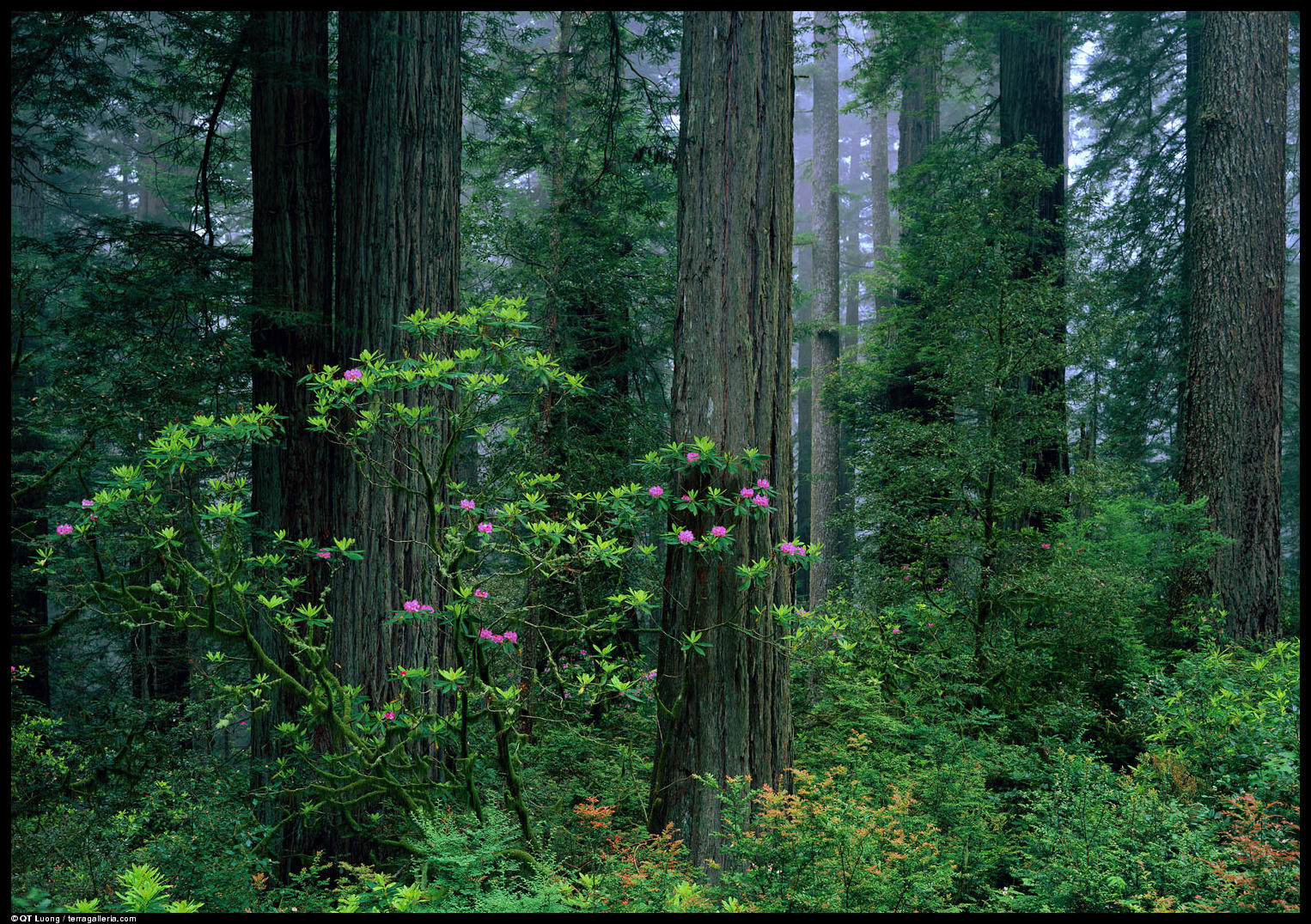

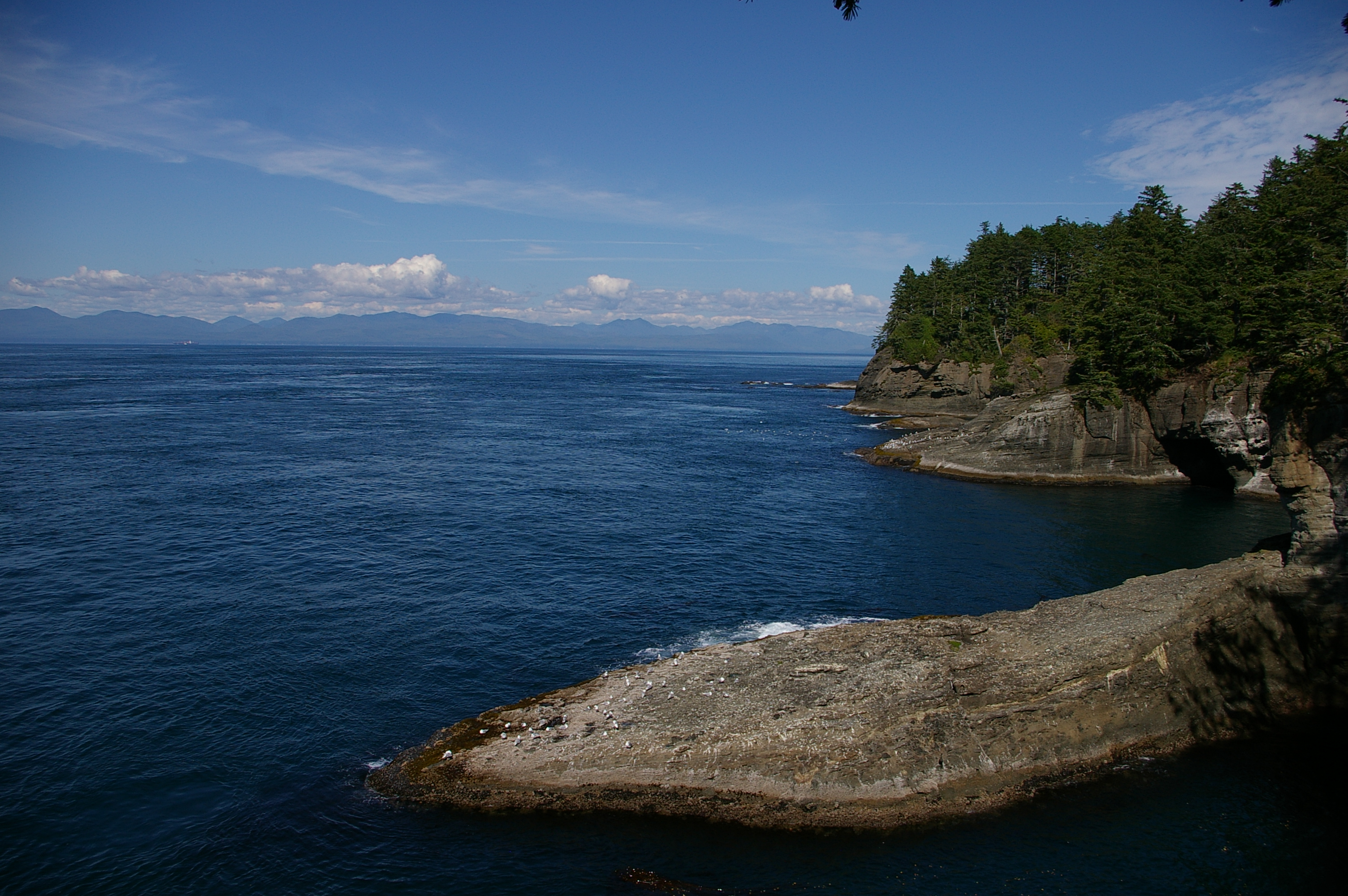


"The amazing thing about Seattle and Vancouver is how different we are, considering our near-identical climates and bioregions, similar hybrid ethnicities and parallel histories. Look at a satellite photo of Puget Sound to Howe Sound, and it’s clear that there is now a border-straddling megalopolis from Lions Bay to Tacoma: seven million people in one virtual city, with the insufferable anomaly of an international border down the middle. With two heads but one conjoined body, Vancouver and Seattle are Siamese twins. Yet we are fused not at the head, but at the back—forever looking in different directions. We may share the same flesh, but our outlooks are, in many ways, starkly different." - From the Seattle Series
The Seattle Series
- 36 Hours in Seattle: Where to eat, shop, sightsee, and take five.
- Bed Check: A look into 3 different hotels
- Culture Crawl: Vancouver's selected music, books, and independent coffee.
- The New Seattle: What Vancouver can learn from its Pacific Sister
- A Tale of Two Cities: A Column Comparison


